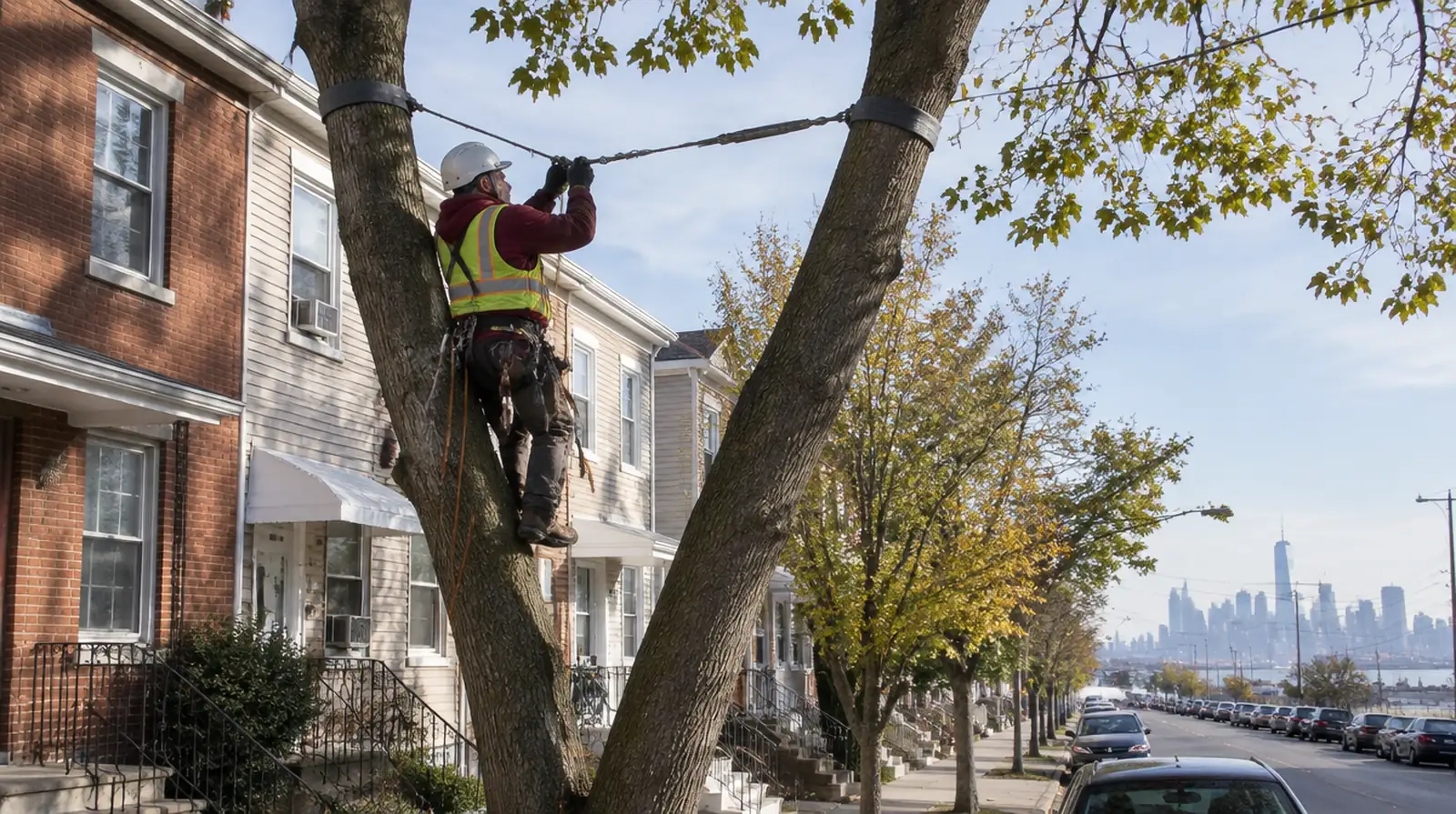
What does tree cabling and bracing do for a Bayonne tree?
Tree cabling and bracing gives a structurally weak tree some help from steel so the weak point is less likely to give way in a storm. It fits trees that are healthy overall with one problem area, such as a split fork or an overloaded limb. It does not suit trees that are already dying or rotting.
A cable is strung between two limbs or stems high in the crown, well above the weak joint, so it has leverage. It is set with a little slack, which lets the tree move normally in light wind and only takes the strain when a gust tries to spread the stems. A brace is a solid threaded rod run through the wood at the crack or fork, pinning the two sides so they cannot pull apart. Badly split trunks around Bayonne often need both, with rods near the split and a cable up top.
Which Bayonne trees are good candidates?
Start by looking at the point where the trunk divides. If two stems of almost equal size rise close together with a tight crease of bark trapped between them, the joint is weak. Other warning signs: a dark seam or crack running down below the fork, one half of the crown moving on its own in wind, or a long limb reaching over the house, garage roof, or the neighbor's yard.
Support is worth it when the rest of the tree is sound, it is big enough to matter, and failure would land on something important. In a city this built up, that describes a lot of trees. Callery pears were planted along many streets for their spring flowers, and their crowded upright branching is known for tearing apart as they mature. On the older blocks of Bergen Point and Midtown, big Norway maples with two leaders and London planes hanging over small rear yards are common calls.
Cabling does not replace pruning. Often taking weight off the ends of the limbs takes most of the strain away, and a cable covers the rest. We'll recommend the mix that suits your tree.
How do weak forks develop?
The flaw forms when the tree is young. A sapling that loses its top or is never pruned to one main stem ends up with two shoots competing for the lead. As they thicken, the bark between them gets pinched in instead of being bridged by solid wood. From the sidewalk the joint looks fine, but it holds much less than a normal branch union, and the risk grows every year as the stems get heavier. Fast growers volunteer and spread here too, including tree of heaven along back fences and silver maple.
The peninsula's exposure tests those joints. Bayonne has water on three sides, so wind off Newark Bay and the Kill Van Kull reaches yards with little to slow it. Nor'easters bring heavy wet snow, and summer storms bring sharp, sudden gusts. Near the waterfront, soil is often fill that stays wet, so roots don't anchor deeply. Steel can help a weak crown, but it won't save a tree whose roots are lifting, so we check the base on every visit.
Cable it or remove it?
Hardware is only as good as the wood it's anchored in. Soft or crumbling wood at the fork, mushrooms at the base, a hollow trunk, or large dead parts of the canopy all mean bolts would have nothing solid to grip. Adding steel to a tree like that only makes it heavier, and removal is the safer call. A limb that has already broken and is hanging after a storm isn't a cabling job at all. Call for emergency tree service.
After seeing the tree in person, we give you a clear answer: support it, prune it and leave it, or plan a removal before the weather forces one. With so little open ground on most Bayonne lots, a mature shade tree is hard to replace, so keeping a sound one is often worth the effort.
What drives the price?
- The amount of hardware. A single cable linking two stems is a short job; multiple cables plus rods take longer.
- Access to the crown. Anchors go high, and when a bucket truck can't reach from the street because of fences, garages, or parked cars, the crew climbs and rigs instead.
- Pruning on the same visit. Lightening the heavy limbs is usually done at the same time.
- Future checkups. The tree grows around its hardware, so it needs a look every few years.
Estimates are free, and the price stays fixed for the scope we agree on. If the climber finds hidden decay once up in the tree, we stop and discuss it with you before anything is installed.
Tree cabling questions from Bayonne homeowners
Will people see the hardware?
The cable sits up in the crown and mostly disappears once the tree leafs out. Rods at the fork are easier to spot from directly underneath.
How long will it last?
The steel itself is durable, but the tree keeps growing around it. The anchors and cable tension should be checked every few years.
Can a leaning tree be helped?
Sometimes, when the lean comes from a lopsided crown and the roots are holding. If the soil is heaved or cracked on the far side of the trunk, removal is usually the answer.
Is a permit needed?
Work on a tree fully on your own property is generally up to you. A tree between the sidewalk and the curb may count as a city street tree, so check with the City of Bayonne before anyone touches it.
Want an honest read on your fork?
Call for a free look at the tree. We'll tell you whether support makes sense, or whether removal is the safer move.
(201) 581-0478